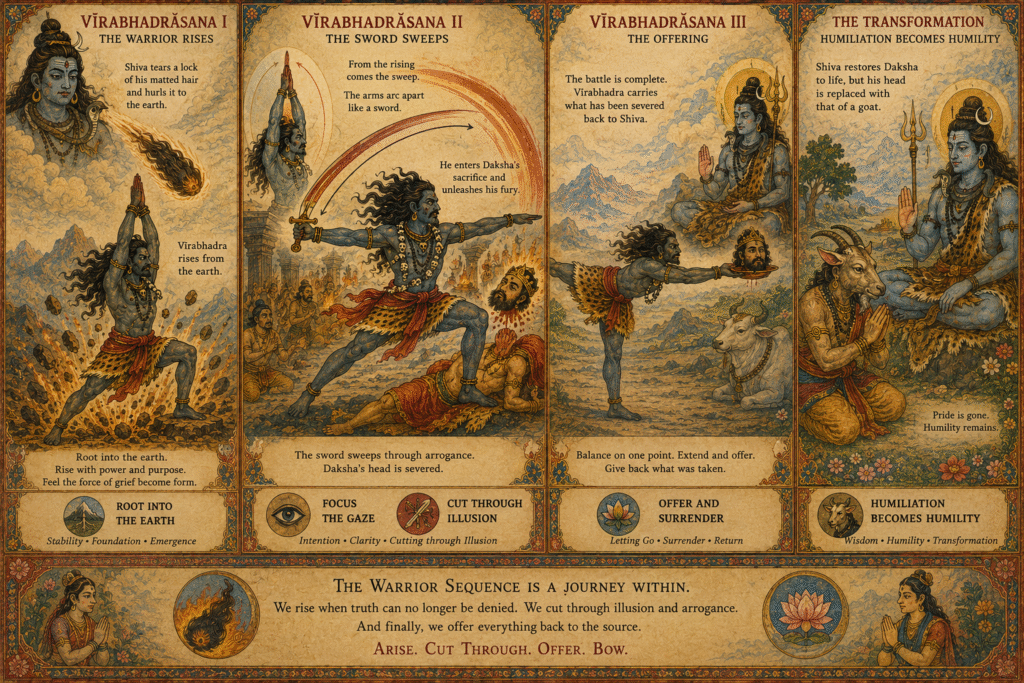
The Warrior Within: The Myth of Vīrabhadra
Yoga postures can be more than shapes we make with the body. They can become myths that we enter.
Perhaps one of the most powerful examples is the sequence of three Warrior poses — Vīrabhadrāsana I, II and III — which we can experience as an embodied retelling of the story of Vīrabhadra, the terrible warrior born from Shiva’s grief.
Rather than merely remembering the mythology while we practise, we can allow the movements themselves to tell the story.
We rise from the earth.
We draw the sword.
We cut away the head.
And finally, we offer what has been severed back to Shiva.
To understand the Warrior sequence in this way, we must first understand why the warrior arose.
The Humiliation of Shiva
Satī was the daughter of the powerful king Dakṣa, but she had chosen as her husband the one being her father could neither understand nor control.
Shiva.
Shiva was everything Dakṣa was not.
Dakṣa represented order, propriety, hierarchy and social standing. Shiva wandered mountains and cremation grounds. His body was smeared with ash. Serpents adorned him. His hair was wild and matted. He meditated beyond the boundaries of conventional society.
To Satī, he was divine.
To Dakṣa, he was an embarrassment.
Dakṣa organised a magnificent yajña, a great sacrificial gathering attended by gods, sages and dignitaries.
Everyone who mattered would be there.
Except Shiva.
The exclusion was deliberate.
Satī went nonetheless.
There, surrounded by the assembled guests, she listened as her father poured contempt upon her husband.
Dakṣa believed he was humiliating Shiva.
But Shiva was not there to be humiliated.
Satī was.
Unable to bear her father’s contempt for the being she loved, Satī turned inward.
Before her burned the sacrificial fire.
Within her arose another fire — the fire of yoga.
And Satī gave herself to it.
She burned.
Far away, Shiva felt the loss.
Grief moved through him.
Then grief became fury.
Shiva tore a lock from his matted hair and hurled it against the earth.
The ground erupted.
And from it rose Vīrabhadra.
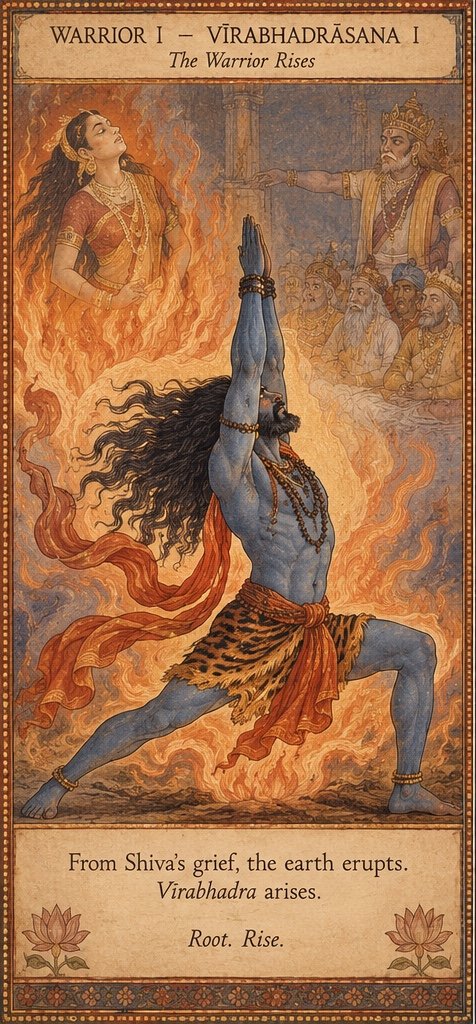
Warrior I — The Warrior Rises
Come into Vīrabhadrāsana I.
Feel the earth beneath your feet.
Press down.
Then rise.
The legs become powerful. The spine lifts. The chest opens. The arms reach upwards.
The posture contains two forces simultaneously: a tremendous rooting into the earth and an equally powerful movement away from it.
This is Vīrabhadra being born.
He does not gently descend from heaven.
He erupts from the ground.
Shiva’s grief has struck the earth and taken form.
Feel that as you enter Warrior I.
Something that was invisible has become embodied.
Something buried has broken through the surface.
We all know such moments.
Grief, anger, fear and injustice can remain beneath us for years until something finally breaks open.
Yoga does not necessarily tell us that these energies are wrong.
Shiva himself gives his fury form.
The question is what we do with it.
Root through the feet.
Reach through the hands.
Let the warrior arise.
From Warrior I to Warrior II — The Sword
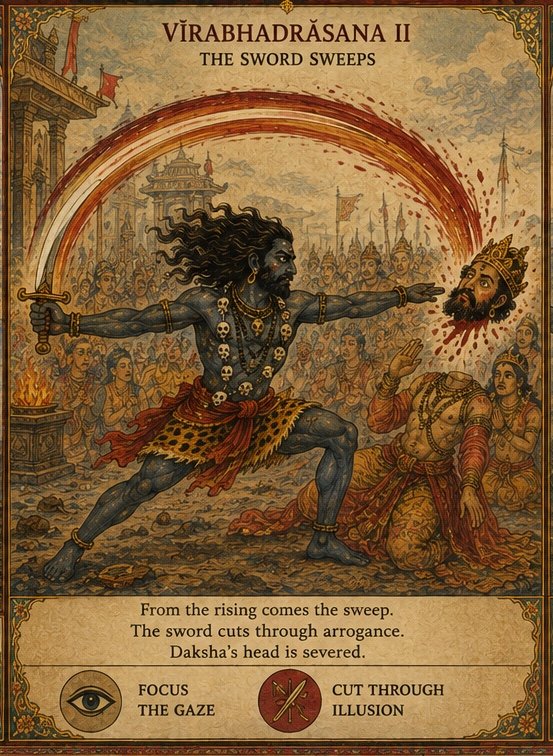
Now comes perhaps the most dramatic movement in the sequence.
Don’t think only about arriving in Warrior II.
Feel the transition.
In Warrior I your arms are raised above you.
Vīrabhadra has emerged.
Then the body turns.
The hips open.
And the arms sweep apart.
Feel the arc they make through the air.
It is the sweep of a sword.
The vertical force of Warrior I suddenly cuts horizontally through space.
Vīrabhadra enters Dakṣa’s sacrifice and unleashes the fury from which he was created.
The great ceremony descends into chaos.
The assembled guests scatter.
And the sword sweeps through them.
Your arms complete their arc and you arrive in Warrior II.
Now become still.
One hand points forwards.
One reaches backwards.
The chest is open.
The legs are grounded.
And the gaze travels relentlessly beyond the fingertips of the forward hand.
Dakṣa stands before you.
The sword has found its mark.
His head falls.
The movement from Warrior I into Warrior II has enacted the whole moment:
emergence becomes action.
But what has actually been cut away?
The Head We Carry
There is something beautifully precise about Dakṣa losing his head.
His problem has always been there.
His certainty.
His judgement.
His status.
His conviction that he knows what is respectable and what is ridiculous, who belongs and who does not.
He looks at Shiva — the ash-covered yogi sitting outside conventional society — and believes that because Shiva does not conform to his idea of dignity, Shiva must therefore be beneath him.
Dakṣa mistakes convention for wisdom.
So Vīrabhadra removes the very thing from which Dakṣa has been judging the world.
His head.
And yoga performs its own version of this operation upon us.
We arrive carrying ideas about ourselves.
We think we are strong.
We think we are flexible.
We think we are balanced.
We think we know our bodies.
Then we enter the posture.
Stay in Warrior II.
Let the front thigh descend.
Stay a little longer.
The leg begins to burn.
Perhaps the hip refuses to open as far as we imagined it would. Perhaps the shoulders tighten. Perhaps the breath becomes strained.
Suddenly what we think about ourselves encounters what is actually happening.
Yoga exposes where we are.
It doesn’t humiliate us.
But it does demand humility.
Warrior III — The Offering
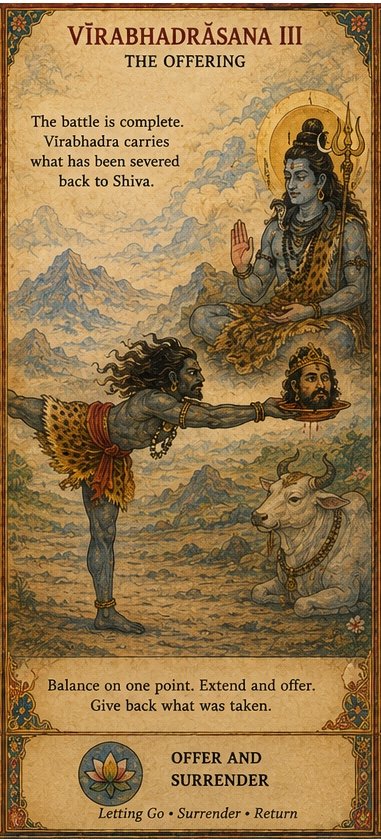
The battle is over.
Dakṣa’s head has fallen.
Now the energy that arose from Shiva must return to Shiva.
Begin to move into Vīrabhadrāsana III.
The great horizontal expanse of Warrior II gathers itself.
The weight moves into one foot.
The body turns and inclines forward.
The rear leg rises.
The torso reaches into space.
And the arms extend ahead.
Imagine Vīrabhadra approaching Shiva.
In his outstretched hands he carries what has been severed.
Dakṣa’s head.
He presents it to the god from whose grief he was born.
And suddenly Warrior III becomes something very different from a demonstration of athletic strength.
It becomes an offering.
Feel what happens in the posture.
In Warrior I we had two feet upon the earth and reached towards heaven.
In Warrior II we spread ourselves magnificently across space.
But now almost everything has been taken away.
One foot.
One point of contact.
The body suspended between earth and sky.
The warrior who arrived in fury must now find stillness.
And anyone who has spent time in Warrior III knows how quickly the pose exposes us.
The standing foot grips.
The ankle trembles.
The body wobbles.
We try harder.
And frequently the harder we try to dominate the posture, the more elusive balance becomes.
Strength brought us here.
But surrender keeps us here.
The warrior offers the severed head to Shiva.
Perhaps we can offer ours too.
The Goat
But this story does not end with revenge.
Shiva arrives at the ruined sacrifice.
His fury subsides.
Before him lies the headless body of the man who despised him.
Shiva could leave Dakṣa there.
Instead, he restores him to life.
But Dakṣa’s old head is gone.
So Shiva replaces it with the head of a goat.
There is something both comic and profound in this transformation.
Dakṣa had been so concerned with dignity, appearances and social standing. He had attempted to make Shiva — the wild, ash-covered yogi — an object of ridicule.
Now Dakṣa awakens wearing the head of an animal.
The humiliation he tried to place upon Shiva has returned to him.
But something has changed.
Dakṣa bows.
The man who believed himself superior has discovered humility.
And Shiva accepts him.
This is where the story becomes much more than revenge.
Humiliation has become humility.
Yoga and the Humbling of the Head
It is easy to judge yoga from the outside.
Yoga has been mocked, trivialised, commercialised and reduced to stretching, gymnastics, fashionable clothing or strange-looking poses.
In a curious way, this repeats Dakṣa’s mistake.
Yoga belongs intimately to the world of Shiva.
Shiva is Ādiyogi, the primordial yogi — the wild figure sitting beyond the boundaries of respectable society, exploring consciousness directly.
Dakṣa looks at Shiva from the outside and believes he knows what he is seeing.
Yoga asks us to stop looking from the outside.
Step onto the mat.
Enter the posture.
Stay there.
Breathe.
Now see what you think.
The body is remarkably uninterested in our opinions of ourselves.
Warrior II does not care how strong we believe ourselves to be.
Warrior III does not care how balanced we imagine ourselves to be.
The posture simply reveals us.
And perhaps that is one of yoga’s greatest gifts.
Again and again we arrive with a head full of ideas about who we are.
Again and again the practice cuts through them.
A judgement falls.
An assumption falls.
An identity falls.
A limitation we had accepted as truth falls.
And like Dakṣa, we rise again.
Perhaps slightly more ridiculous.
Certainly more humble.
But alive.
Enter the Myth
So the next time you practise the Warrior sequence, don’t merely move through three poses.
Enter the story.
Step into Warrior I.
Press down into the earth.
Feel the opposing force rising through your legs, spine and arms.
Shiva’s grief strikes the earth.
Vīrabhadra erupts from it.
Arise.
Then begin the movement into Warrior II.
Don’t rush it.
Feel your arms sweep from above your head and carve their enormous arc through space.
Feel the sword moving through the air.
The head of certainty is severed.
Settle into Warrior II.
Look beyond your fingertips.
Cut through.
Then gather yourself and move into Warrior III.
One foot remains upon the earth.
The body extends forward.
Reach through the hands.
Carry the severed head towards Shiva.
Give back the certainty.
Give back the judgement.
Give back the person you thought you had to be.
Offer.
And when the ankle begins to tremble, when the body wobbles and perhaps you tumble completely out of the pose, remember Dakṣa waking with his goat’s head.
Smile.
There is nothing wrong with discovering where you actually are.
That is where yoga begins.
The Warrior sequence is not ultimately about conquering somebody else.
It is about having the courage to encounter ourselves.
The warrior rises.
The sword cuts through illusion.
The head is surrendered.
And what returns is humbled, changed and given another chance.
Arise. Cut through. Offer.
Then bow.