
The Cosmic Dance of Shiva
There are few yoga poses that capture the imagination quite like Natarajasana, Dancer Pose. Balanced on one leg, the body arcs backwards while the other leg rises behind, creating a posture that seems to contain both stillness and movement.
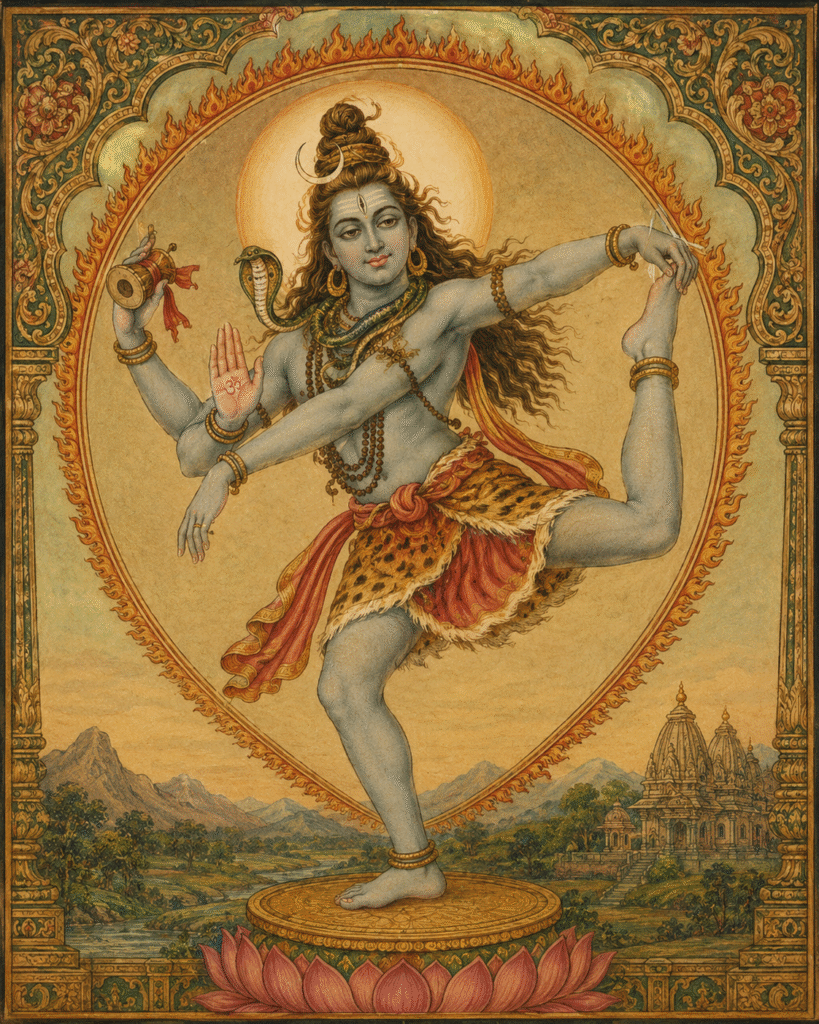
Its name invokes Nataraja — Shiva as Lord of the Dance — one of the most extraordinary images in Hindu art and philosophy.
Shiva dances within a circle of fire. In one hand he holds the drum from which creation emerges; in another, the flame through which creation is destroyed. One hand offers protection, while beneath his foot lies the dwarf of ignorance. Yet through all this movement, Shiva’s face remains utterly serene.
It is an image of existence itself: everything moving, everything changing, everything being born and dying — while at the centre remains something unmoved.
And this paradox is also at the heart of Natarajasana.
What Does Natarajasana Mean?
The Sanskrit name Naṭarājāsana (नटराजासन) can be broken down into:
Naṭa — dancer
Rāja — king or lord
Āsana — posture or seat
Nataraja therefore means “Lord of the Dance” or “King of Dancers,” an epithet of Shiva in his dancing form.
Natarajasana can consequently be translated as “Pose of the Lord of the Dance.”
But to understand what that name really evokes, we need to understand the dance itself.
The Story of Shiva Nataraja
One of the great traditions surrounding Nataraja takes us to the sacred forest of Tillai, associated with present-day Chidambaram in Tamil Nadu.
According to the tradition, powerful sages lived in the forest, confident in the efficacy of their rituals and magical practices. Shiva appeared among them disguised as Bhikshatana, the wandering mendicant.
The sages became enraged and attempted to destroy him through their magic.
They sent a tiger against Shiva.
Shiva killed it and wrapped its skin around himself.
They sent serpents.
Shiva transformed them into ornaments.
Finally, they produced a dwarf-like demon associated with ignorance and forgetfulness, often known as Apasmara or Muyalaka.
Shiva placed him beneath his foot.
And then Shiva danced.
This is the Ananda Tandava — the Dance of Bliss.
The image is not simply one of Shiva defeating enemies. Something much more profound is being expressed.
Ignorance is held beneath his feet, yet the universe continues to whirl around him.
Shiva does not escape the world.
He dances it.
What Do the Historical Texts Actually Say?
Here an important distinction needs to be made.
The tradition of Shiva as the divine dancer is much older than the modern yoga posture called Natarajasana.
Chidambaram became particularly associated with Shiva’s Dance of Bliss, and magnificent bronze representations of Nataraja flourished under the Chola dynasty of southern India.
The symbolism of the dance is also described explicitly in the Tamil Shaiva philosophical tradition.
The medieval Unmai Vilakkam, a text associated with Shaiva Siddhanta, explains the imagery of Nataraja through Shiva’s cosmic activities.
The drum signifies creation.
The protecting hand signifies preservation.
The fire signifies destruction.
The foot upon the dwarf is associated with concealment or obscuration.
And the raised foot offers liberation.
Together these become Shiva’s five acts — Panchakritya:
Srishti — creation
Sthiti — preservation
Samhara — destruction or dissolution
Tirobhava — concealment or veiling
Anugraha — grace or liberation
This is important because Nataraja is sometimes reduced in popular explanations to “Shiva the destroyer.”
The symbolism is far richer than that.
Shiva is not simply destroying the universe. He is creating it, sustaining it, dissolving it, concealing its ultimate nature and revealing that nature again through grace.
The dance is the entire process.
Was Natarajasana an Ancient Yoga Pose?
Probably not — at least, there is currently no good historical evidence that the posture we practise today as Natarajasana was an ancient hatha yoga asana.
This is where mythology and history need to be separated.
Natarajasana does not appear in the principal medieval hatha yoga texts in the form familiar to modern practitioners. Yoga historian Elliott Goldberg has argued that the posture entered modern yoga through T. Krishnamacharya in the twentieth century, later becoming particularly associated with his student B.K.S. Iyengar.
There is, however, an intriguing older visual connection.
Dance-like poses resembling Natarajasana appear among sculptures associated with the great Nataraja Temple at Chidambaram, reflecting the long relationship between Shiva, sacred movement and Indian dance traditions.
So it would be misleading to say that ancient yogis had always practised Natarajasana in honour of Shiva.
Something subtler seems to have happened.
An ancient religious image and philosophy eventually found expression through a modern yoga posture.
And perhaps that distinction makes the pose more interesting rather than less.
How Did Natarajasana Become Associated With Shiva?
The connection is immediately visible.
The practitioner balances upon one leg while the other rises behind the body. The chest opens, the spine curves and the body seems momentarily suspended between movement and stillness.
It evokes the dancing Shiva.
B.K.S. Iyengar explicitly connected Natarajasana with Shiva’s dance in Light on Yoga, describing Shiva as Lord of the Dance and discussing the Tandava.
As modern postural yoga developed, the ancient image of Nataraja provided both a name and a symbolic framework for the posture.
Yet the relationship between them goes deeper than physical resemblance.
The mythology gives us a way of understanding what the posture feels like from within.
The Symbolism of Nataraja’s Cosmic Dance
The famous image of Nataraja can almost be read as a map of existence.
Every major element carries meaning, and together they express a universe that is continually appearing, existing, disappearing and being born again.
The Damaru — Creation
In one hand Shiva holds the small hourglass-shaped damaru drum.
Its beat represents creation: the primordial rhythm from which manifestation emerges.
Before there can be music, there must be rhythm. Before there can be a dance, there must be a beat.
Symbolically, the damaru is that first pulse — the beginning of movement within stillness.
Abhaya Mudra — Preservation and Protection
Another hand is held in Abhaya Mudra, the gesture of fearlessness and protection.
Its message is simple:
Do not be afraid.
The universe changes continually, yet there is something within us capable of meeting that change without fear.
Agni — Destruction and Transformation
In another hand Shiva holds fire — Agni.
If the drum brings the universe into existence, the flame consumes it.
But destruction within Indian philosophy is not necessarily negative.
Without destruction there could be no transformation.
The flower must die for the seed to appear. The old identity must sometimes dissolve before another can emerge. Breath enters the body, remains for a moment and leaves again.
Creation and destruction are therefore not enemies.
They are partners in the same dance.
Apasmara — Ignorance Beneath Shiva’s Feet
Beneath Shiva lies the small dwarf-like figure of Apasmara, associated with ignorance, forgetfulness and spiritual blindness.
Shiva does not destroy the changing world beneath his feet.
He subdues ignorance about its nature.
Our suffering often comes not simply because things change, but because we demand that changing things remain unchanged.
We cling. We resist. We attempt to freeze the dance.
Nataraja invites another possibility: to participate completely in life while recognising its movement.
To dance without needing the dance to stop.
The Raised Foot — Liberation and Grace
One of Shiva’s feet remains planted upon Apasmara.
The other is raised.
The raised foot represents grace and liberation — Anugraha.
One foot subdues ignorance.
The other offers freedom.
Liberation is not found by escaping the cosmic dance, but by seeing the dance for what it is.
The Circle of Fire — The Ever-Changing Universe
Shiva dances within a great ring of flames.
This circle can be understood as the ceaseless movement of manifestation — the universe continually appearing, transforming and disappearing.
Nothing within it remains fixed.
Bodies change. Relationships change. Civilisations rise and disappear. Thoughts appear and vanish. Even stars are born and eventually die.
Shiva does not stand outside this process.
He dances within the flames.
This is one of the great paradoxes of the image: perfect tranquillity existing within absolute movement.
Look carefully at the face of Nataraja.
Around him the universe is on fire. His limbs dance. His hair flies outward. Creation and destruction occur simultaneously.
And yet his expression remains calm.
Experiencing the Mythology in Natarajasana
This is where mythology can cease being merely a story and become something experienced through the body.
Natarajasana demands movement and stillness simultaneously.
One foot roots firmly into the earth while the rest of the body expands away from it. The standing leg must remain stable, yet rigidity makes the posture difficult.
The lifted leg moves backwards. The chest moves forwards and upwards. The spine curves. The gaze becomes steady.
The body is being pulled in different directions, yet balance appears somewhere between them.
This is Nataraja’s paradox made physical.
Stillness is not the absence of movement.
It can exist at the centre of movement.
The harder we desperately try to freeze ourselves in Dancer Pose, the more precarious the balance often becomes. Instead, balance requires thousands of tiny adjustments.
The ankle moves. The toes respond. The breath changes the ribs. The nervous system continually recalibrates.
What appears from outside to be stillness is actually an extraordinarily complex dance.
And perhaps consciousness is something similar.
Thoughts arise. Sensations appear. Emotions move through us. The world continually changes.
Meditation does not necessarily require destroying this movement.
It can mean discovering the awareness within which the movement occurs.
The dancer moves.
The dance changes.
Yet awareness remains.
Stillness at the Centre of the Dance
There is an even deeper element within the Shaiva tradition.
The Unmai Vilakkam does not describe Shiva’s dance merely as something happening somewhere in the heavens.
The dance occurs within the soul.
The macrocosm and microcosm mirror one another.
The cosmic process occurring throughout the universe is also occurring within us.
Every moment contains creation and destruction.
A thought appears and disappears. A breath is born and dies. An identity forms and eventually dissolves.
Even the body performing Natarajasana is not the same body from one second to the next.
The pose therefore offers an interesting contemplation.
Standing on one leg, surrounded metaphorically by Shiva’s circle of fire, we attempt something apparently impossible:
to surrender to movement without losing our centre.
Perhaps that is why the ancient image of Nataraja remains so powerful.
It does not ask us to escape impermanence.
It asks us to recognise its rhythm.
Creation and destruction are not opposites.
They are movements within the same dance.
Stillness and movement are not opposites either.
At the deepest point of the dance, they meet.
And for one precarious, beautiful moment in Natarajasana, we may experience something of what the image of Shiva has been telling us for centuries:
Do not try to stop the dance.
Find the stillness from which you can dance.
Sources and Further Reading
Unmai Vilakkam (Light of Truth) — a medieval Tamil Shaiva Siddhanta text particularly valuable for understanding the five activities represented in Nataraja’s dance.
Ananda K. Coomaraswamy, “The Dance of Śiva” — the influential early twentieth-century essay that helped introduce the philosophical symbolism of Nataraja to a wider Western audience.
B.K.S. Iyengar, Light on Yoga — an important source for the modern practice of Natarajasana and its association with Shiva.
Elliott Goldberg, The Path of Modern Yoga — useful for understanding the development of modern postural yoga and the twentieth-century history of Natarajasana.
Smithsonian National Museum of Asian Art — “The Origins of Shiva Nataraja” — useful background on Chidambaram, Chola culture and the historical development of Nataraja imagery.